
Crnogorski Telekom and ENT Continue Cooperation
Crnogorski Telekom and Ericsson Nikola Tesla continue their successful cooperation aimed at modernizing and improving Telekom’s 5G network.

European operator bosses warned that sovereignty is the latest field in which strict regulation is hampering progress. They have highlighted the US and China as champions of their own destiny.
CEOs of Deutsche Telekom, Telefonica, and Eutelsat explained that European players are actually well placed to provide sovereign services, but need some help to build the ecosystems. Telefonica chief Marc Murtra said the nature of existing telecoms infrastructure means all data revolves around operators, putting them in a good position to ensure sovereignty.
But he believes work is needed to produce local hyperscale-level software to develop products to unlock digital economies. Murtra argued it is naive to think that we are going to be given, as Europeans, access to the latest AI products that will be needed in ten years for industrial use cases. “All these products are very hard to make and very expensive, and I think we do have the know-how, but we don’t have the orchestration”.
Jean-Francois-Fallacher, CEO of Eutelsat, said that fragmentation in Europe must be addressed if satellite players are to tackle competition from gigantic US and Chinese competitors. He explained Europe remains more a collection of 27 nations, noting that there is always the temptation to build one's own local, national platforms to address sovereignty requirements rather than finance regional initiatives.
Deutsche Telekom CEO Tim Hoettges is a longstanding advocate of how the US does business and asserted that low margins in the European telecoms sector are stifling the ability to invest in innovative services. For all that Hoettges offered his now trademark scathing view of European telecoms regulation, he noted that politicians cannot shoulder all the blame for the lead the US and China have carved out. He explained there are opportunities to truly deliver on the promise of Industry 4.0 because technologies, including cloud data storage, compute capacity, AI, chipsets, and connectivity, are now aligning.
But he noted the problem is that the US, in particular, is already well advanced in employing the elements. The US is “investing in exactly these things. They have the chipsets, they have the data centres, they have the AI tools, they have the connectivity, and on top of all that, they are developing the automation tools that they can take advantage of all this production”. Europe must take ownership of each element if it wants to compete, he said.
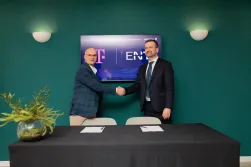
Crnogorski Telekom and Ericsson Nikola Tesla continue their successful cooperation aimed at modernizing and improving Telekom’s 5G network.
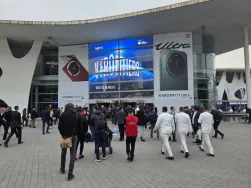
MWC 2026 concluded its jubilee twentieth edition in Barcelona with nearly 105,000 visitors from 207 countries and territories, confirming that the event remains the central gathering point of the global connectivity and digital technology industry.
The European market for smartphones and wearable devices remains highly competitive, pushing manufacturers to look for new ways to differentiate through technology, ecosystems, and product strategy.


